One platform for 12 European markets
For Sharp, we rebuilt a slow product website as a single multisite platform for 12 markets and more than 4,000 products.
Product data now syncs from the central PIM almost instantly, and search responds in milliseconds.
12
European markets
4,000+
products in the catalogue
5
months from takeover to launch
33
editorial blocks
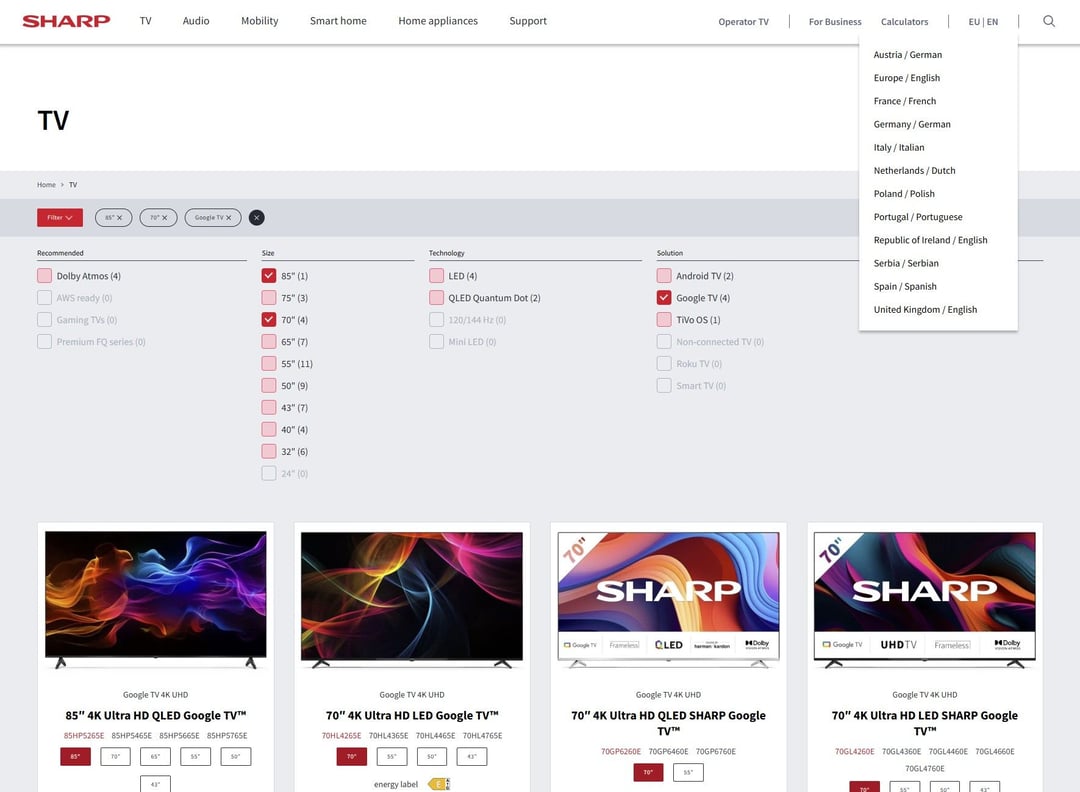
Sharp needed more than a new website
With a catalogue this large, Sharp’s original product website was no longer up to the job.
The site was slow, and syncing product data from the PIM system was complicated and badly delayed. New or updated information could take several days to appear on the website.
The brief also covered a redesign and a platform that could serve multiple European markets without each one running as a separate website.
PIM
product data
WordPress database
slow queries with a large catalogue
The brief had three goals
Speed up the website and product catalogue
The original implementation could not cope with thousands of products.
Get data from the PIM onto the website almost instantly
New information took several days to appear on the website.
Build one foundation for 12 markets
Otherwise every market would be a separate website to maintain on its own.
We took over the project and rebuilt it
We took over the project from the German agency that built the original website.
We didn’t patch the existing architecture piece by piece. We rethought how product data reaches the website and how it is searched.
The goal was to reduce dependence on the WordPress database, speed up work with the product catalogue and create a more reliable data flow.
Less reliance on the WordPress database: better performance, more reliable data flow.
The PIM stayed the source of truth.
WordPress got a different job.
The biggest change: the product catalogue no longer lives in the WordPress database.
PIM
central product data
Typesense
search and filtering
WordPress multisite
content and presentation
12 markets
local versions of the platform
The PIM remains the central source of product data. A custom connector listens for changes via webhooks and syncs them to Typesense.
Typesense handles full-text search and filtering across more than 4,000 products. WordPress remains the editorial environment for content and individual pages.
We separated data, search and content so that each system does what it is best at.
From several days
to almost instant sync
The original product data sync was slow and error-prone.
How it works today
Webhook
A change in the PIM triggers a notification.
Buffer
Larger volumes of changes are collected.
Batch processing
Data is processed in batches.
Retries
If something fails, the write is retried.
Conflict-safe writes
Conflicting writes cannot overwrite each other.
A product change in the PIM shows up on the website almost instantly, not after several days.
4,000+ products.
Results in milliseconds.
With a catalogue this size, we built full-text search and filters on Typesense instead of conventional database queries.
Users can search and filter the whole catalogue instantly. The index also includes older products that are no longer in the current PIM data, and the catalogue stays fast even with thousands of items.
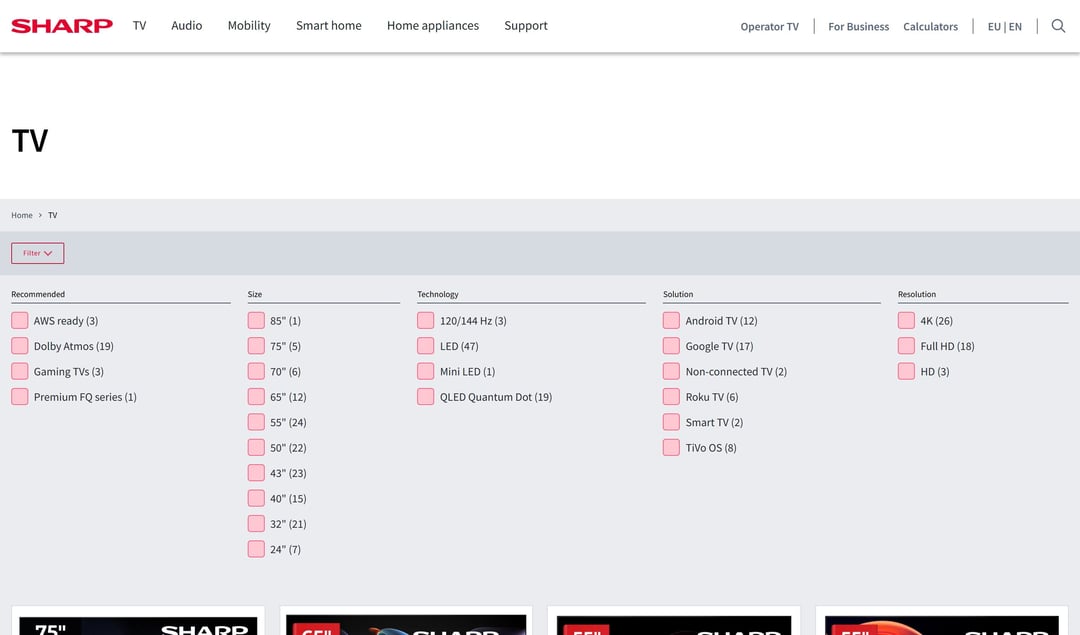
The WordPress database does not slow search down.
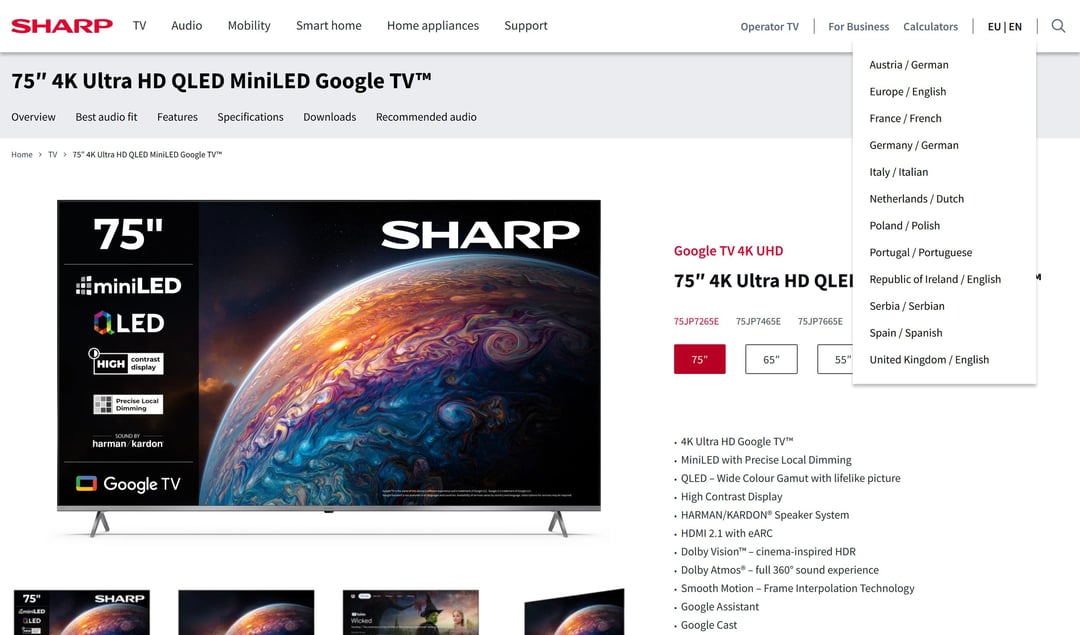
12 markets.
One foundation.
Sharp now runs on a single WordPress multisite platform for 12 European markets.
The markets share code, design, components, a media library, product data and technical infrastructure. Each market is still managed separately.
So adding another market doesn’t mean building another website from scratch. The platform is extended through configuration.
Markets on the platform
Austria
Germany
Spain
France
Ireland
Italy
Netherlands
Poland
Portugal
Serbia
United Kingdom
Europe
One platform, twelve markets. The next one is just configuration.
Editors do not wait for a developer
We built the new WordPress site as a component-based CMS with 33 custom blocks.
Editors use them to build product and content pages without a developer.
Product sections, lists, search and other elements are not hard-coded into individual pages.
That makes day-to-day site management simpler while keeping each market’s design and structure under control.

We did not leave speed until after launch
We made performance decisions as early as the architecture design.
Besides moving product data out of the WordPress database, we used multi-layer caching, image optimisation and other measures aimed at Core Web Vitals.
Speed is built into the platform’s architecture.
From takeover to launch in five months
We worked in two-week sprints with regular feedback from the client. Throughout development, Sharp had an ongoing view of the project’s status and could change priorities as its needs changed.
5 months
June–October 2024
agile development
two-week sprints
The project did not end at launch
After launch, we stayed on as the partner for the platform’s operation and further development.
Sharp gets operation, maintenance and further development from a single partner.
SLA
Monitoring, updates and guaranteed response times.
Maintenance
Ongoing performance tuning and technical care.
Development
New features, components and markets as the brand needs them.
On launch day, operation and further development begin.
From 12 separate websites to one platform
Product data from the central PIM syncs almost instantly. Search and filtering stay fast even with a catalogue of more than 4,000 products.
Editors have their own components for managing content, and another market can be added without building a new website from scratch.
Technology and architecture
We choose technology to fit the project, not the project to fit the technology. These are the decisions that gave Sharp speed, and one platform instead of twelve.
Platform foundation
WordPress Multisite
Twelve markets run on a single installation with shared code, design and media library. A new market is added through configuration.
Bedrock
The project is structured as a modern PHP repository: dependencies via Composer, configuration in environment variables, and separate environments for testing and production.
Sage
Templates are kept separate from logic and built from components. That is what lets 33 editorial blocks run without duplicated code.
Data and search
Typesense
The product catalogue lives in a dedicated search engine, outside the WordPress database. Full-text search and faceted filters respond in milliseconds, even across 4,000 products.
PIM integration
The PIM remains the single source of truth for products. The website only displays the data and keeps no copy of its own, so the same product can never have a different status in two places.
Webhooks
A change in the PIM announces itself, instead of the whole catalogue being pulled at regular intervals. Bulk changes are collected in a buffer and processed in batches.
Performance
Multi-layer caching
The cache has several layers, and only a request that none of them can serve reaches PHP.
Core Web Vitals
We measure speed by what Google assesses and users notice: LCP, CLS and INP. Image optimisation and loading order are both based on these metrics.
Custom routing for product pages
URLs such as /tv/75jp7265e/ are not backed by any WordPress page. The routing builds them from Typesense data.
Other platforms we run



Even a finished product can get a new architecture.
Let’s look together at what needs to change in your solution to make it faster and more reliable, and what can stay as it is.
No-obligation consultation.
We reply within 24 hours.